
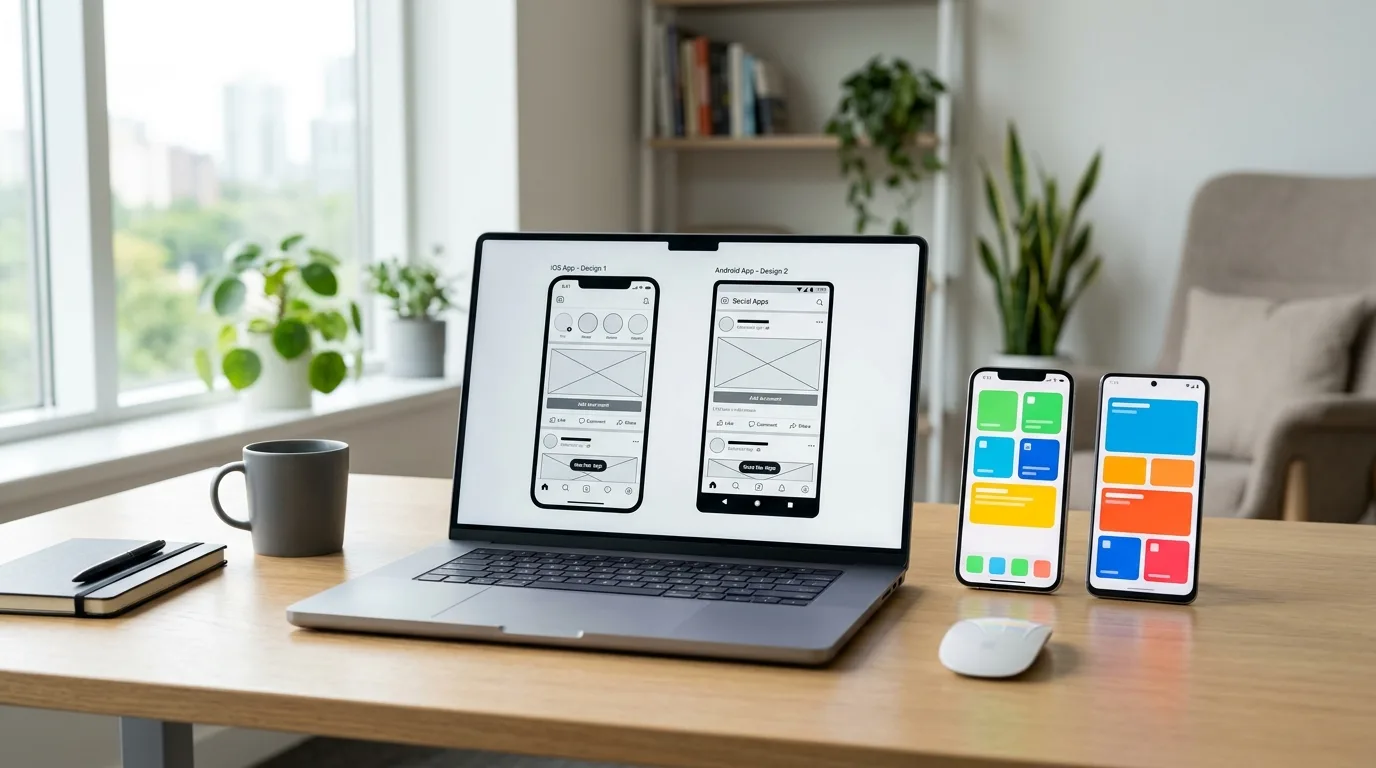
For startup founders and product managers, turning an app idea into a market-ready product involves critical technical decisions. Among the most impactful decisions is selecting your mobile app development framework. Choosing the wrong tech stack early on can deplete your budget, delay launch timelines, and create long-term technical debt.
The core debate usually comes down to cross-platform frameworks—primarily Flutter—versus native development using Swift for iOS and Kotlin for Android. Both approaches have clear advantages, but they serve different business needs, technical requirements, and financial realities.
Understanding these trade-offs helps you align your mobile app strategy with your budget, launch goals, and product roadmap.
Understanding the Strategic Differences
Before evaluating features and performance benchmarks, it is essential to understand how these technologies build and run applications.
What Is Native Development?
Native development means building separate applications for iOS and Android using the platform vendors' official programming languages and tools: Swift with Xcode for Apple devices, and Kotlin with Android Studio for Android devices. Because native apps interact directly with hardware and operating system APIs, they offer optimal performance and immediate access to new platform features.
What Is Flutter Development?
Flutter, an open-source UI software development kit created by Google, enables developers to compile applications for iOS, Android, web, and desktop from a single Dart codebase. Unlike other cross-platform frameworks that rely on web views or JavaScript bridges, Flutter renders its UI directly using its own high-performance graphics engine.
Key Criteria for Evaluation
When selecting the tech stack for your mobile application, evaluate these core operational and technical factors:
1. Time to Market and Initial Investment
For early-stage startups testing product-market fit, speed and cost efficiency are crucial. Building native applications requires two separate codebases, distinct development teams, and duplicate effort for feature updates, testing, and maintenance.
Flutter allows engineering teams to write code once and deploy across both major operating systems. This typically reduces initial development hours by 30% to 40% compared to dual-native builds. A single cross-platform team also simplifies project management and speeds up iterative feature releases.
2. UI Complexity and Platform Aesthetics
Native platforms use platform-specific UI design systems—Human Interface Guidelines for Apple and Material Design for Android. If your application relies heavily on operating-system-level widgets, split-screen capabilities, or platform-native navigation paradigms, native development offers seamless integration out of the box.
Flutter provides absolute control over pixels. Because Flutter renders graphics directly, your app UI looks and behaves identically across older and newer devices on both iOS and Android. This makes Flutter ideal for branded experiences, custom animations, and consistent design systems.
3. Performance and Hardware Integration
For most business tools, e-commerce stores, booking engines, and content apps, Flutter delivers smooth performance up to 60 frames per second (or 120 fps on supported displays). However, resource-intensive applications require a different approach.
If your application relies heavily on real-time video processing, advanced augmented reality (AR/VR), low-latency Bluetooth device control, or heavy background computations, native development provides direct hardware access without bridge overhead.
Common Mistakes to Avoid
When planning your mobile application architecture, avoid these frequent traps:
- Choosing native purely out of habit: Developing two separate native applications when a cross-platform solution meets every requirement inflates your engineering budget and slows down product iteration.
- Assuming cross-platform means zero native code: Complex cross-platform applications often require custom native modules or plugins for platform-specific hardware features.
- Ignoring long-term maintenance costs: Every platform update or OS release requires maintenance. Supporting two native applications requires double the ongoing maintenance effort compared to a shared codebase.
- Overlooking team expertise: Selecting a framework without evaluating available development resources can lead to poor code quality and project delays.
Decision Framework: Which Approach Fits Your Business?
Consider a practical comparison across typical business scenarios:
Scenario A: Early-Stage SaaS MVP. A founder needs to launch a subscription management portal on iOS and Android within three months to secure seed funding. In this case, Flutter provides the fastest path to market with unified design and lower initial development costs.
Scenario B: High-Precision Audio/Video Editor. An enterprise team is building a live video editing tool using local device hardware acceleration. In this case, native development (Swift and Kotlin) ensures maximum hardware control and performance.
If you are planning a new mobile application, reviewing our technology services or exploring our past projects in our portfolio can help clarify the right technical path for your team.
Frequently Asked Questions
Is Flutter suitable for enterprise-scale mobile applications?
Yes. Many large global brands and financial institutions use Flutter for customer-facing mobile apps because of its maintainability, performance, and strong security capabilities.
Can we switch from Flutter to native development later?
While you cannot automatically convert Dart code to Swift or Kotlin, you can integrate native screens into a Flutter app or embed Flutter modules into existing native applications when necessary.
Will a Flutter app look like an Android app on an iPhone?
No. Flutter allows developers to apply Cupertino (iOS-style) widgets on iOS devices and Material design on Android devices, or create a completely custom branded design system across both platforms.
Next Steps for Your Mobile Strategy
Selecting between Flutter and native development requires balancing business constraints, target audience preferences, and long-term product vision. Starting with a clear technical roadmap ensures efficient resource allocation and a reliable product launch.
If you are planning a mobile application and need technical advice tailored to your project, feel free to contact our team or request a project evaluation through our quote calculator.