
Introduction: When Systems Fail, Communication Matters Most
When a cloud service or digital platform experiences unexpected downtime, the first reaction from users is rarely panic—it is uncertainty. Without clear communication, customers flood support channels, assume their own data is lost, or question their subscription. A well-designed, customer-facing status page acts as a single source of truth during these high-stress moments, transforming chaos into clarity.
However, many organizations treat status pages as an afterthought, burying them behind complicated menus or populating them with dense technical jargon. To truly reduce confusion during service disruptions, a status page must be deliberate, accessible, and structured around the user experience rather than internal system architecture.
Structuring Component Status Clearly
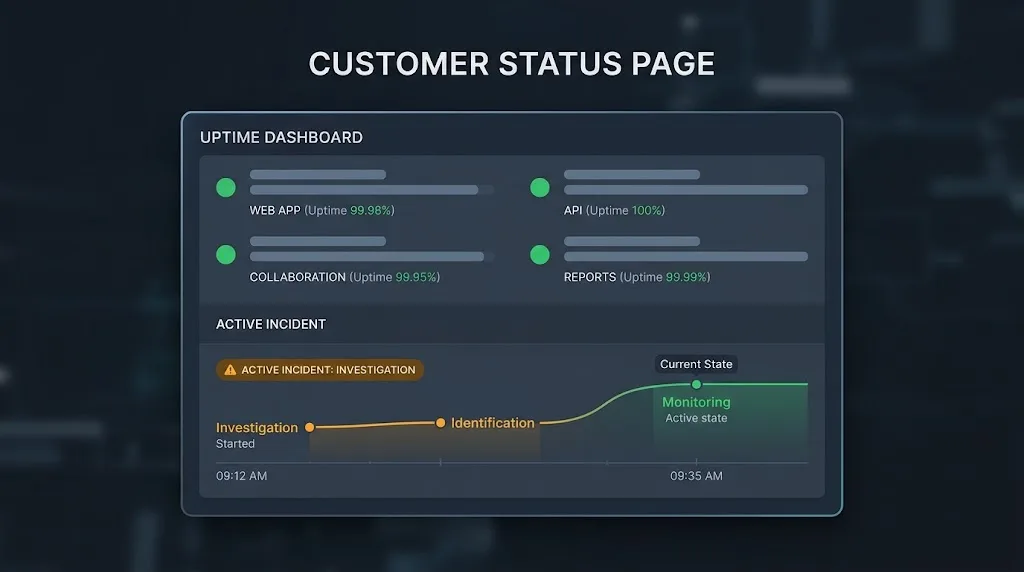
The foundation of any effective status page is its component list. Users do not care about individual database sharding nodes or internal microservices; they care about the core features they rely on to do their jobs. Breaking down system status into high-level, customer-facing components prevents cognitive overload.
Consider NovaScale Cloud, a fictional project management software provider. Instead of listing fifty internal server clusters, their status page tracks four intuitive components:
- Web Application & Dashboard: The primary browser interface.
- API & Webhooks: External integrations and automated workflows.
- Real-Time Collaboration: Live document editing and chat features.
- Export & Reporting Engine: Scheduled data exports and PDF generation.
By mapping components to user-facing workflows, customers can immediately identify whether the specific feature they need is operational, degraded, or completely offline.
Identifying and Categorizing Affected Users
Not every outage impacts 100% of a user base. Multi-tenant architectures often experience isolated regional issues or database-tier specific slowdowns. Failing to specify who is affected leads to unnecessary panic across your entire customer base.
When drafting an incident notice, clearly delineate the scope of impact. For example, if a degraded storage cluster only affects European enterprise accounts utilizing legacy integrations, state that explicitly. Transparent scoping reassures unaffected customers that their operations remain secure and allows impacted users to calibrate their expectations accordingly.
Crafting Incident Timelines and Real-Time Updates
Silence breeds speculation. During an active outage, customers prefer frequent, honest updates—even if the update simply confirms that the engineering team is still investigating. An effective incident timeline follows a structured lifecycle:
- Investigation: Acknowledging abnormal error rates or monitoring alerts before the root cause is confirmed.
- Identified: Pinpointing the exact subsystem or external dependency causing the disruption.
- Monitoring: Applying a fix and observing system metrics to ensure stability.
- Resolved: Confirming full service restoration and closing the incident.
Crucially, every update should be timestamped and written in plain language. Avoid burying updates in technical code snippets or ambiguous jargon that forces users to guess the operational impact.
Writing Accurate Updates When the Cause Is Unknown
One of the hardest challenges in incident communication is writing the first update when engineers are still staring at raw logs and alerts with no clear diagnosis. Waiting until you know the exact root cause delays communication dangerously.
Instead, follow a simple rule: communicate what you know, what you are doing, and when you will provide the next update. An initial message such as, "We are investigating elevated error rates affecting dashboard logins. Our team is actively analyzing metrics, and we will provide another update in 30 minutes," satisfies user need for acknowledgment without fabricating premature conclusions.
Managing Scheduled Maintenance Notices Proactively
Unannounced downtime destroys trust, but even scheduled maintenance can trigger anxiety if communicated poorly. A proper maintenance notice should be published well in advance—ideally 48 to 72 hours—directly on the status page and within relevant application dashboards.
Maintenance windows should clearly state the expected start time, estimated duration, and potential side effects (such as intermittent API timeouts or brief read-only modes). Once maintenance concludes, immediately update the status to reflect normal operations or note any lingering post-maintenance verification.
Establishing Clear Update Ownership
During a critical incident, engineering teams are laser-focused on remediation, while support teams are overwhelmed with inquiries. Confusion over who owns status page updates often leads to delayed messaging or conflicting statements across support tickets and social media.
Operationalizing update ownership requires assigning a designated "Incident Communicator" role during major events. This individual coordinates directly with the lead engineer to draft, review, and publish status updates, ensuring that all external communication remains unified, accurate, and empathetic.
Conclusion
A customer-facing status page is more than a technical tool—it is a cornerstone of customer trust and transparency. By focusing on intuitive components, precise impact scoping, structured timelines, and disciplined update ownership, organizations can turn stressful outages into opportunities to demonstrate reliability and care.


